

Blog
Codificador lineal HEIDENHAIN LS 187C (ID 526974-12) de 1240 mm


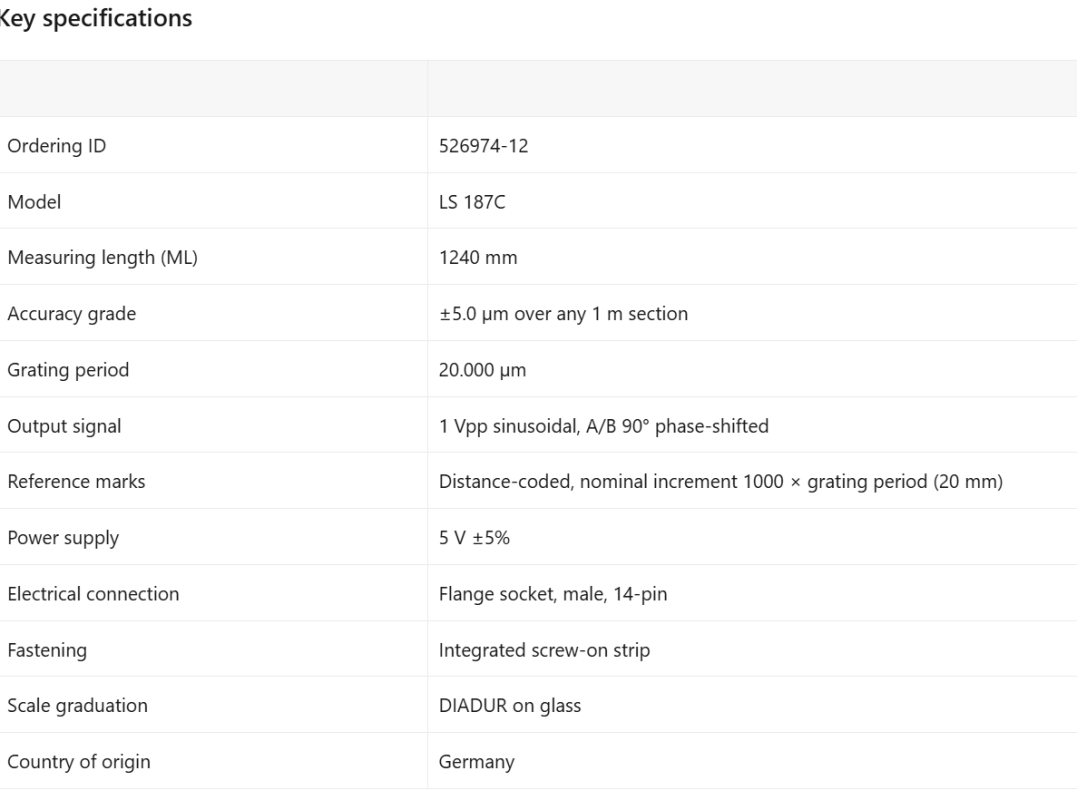
The HEIDENHAIN LS 187C with ID 526974-12 is a sealed incremental linear encoder with a 1240 mm measuring length, a ±5 µm accuracy grade and a 1 Vpp sinusoidal output. The scale carries a 20 µm DIADUR grating and distance-coded reference marks on a 20 mm nominal increment, which lets the control establish its datum after a short traverse instead of a full-stroke return to a single mark.
That combination — a metre-plus of travel, a sealed housing, accuracy inside 10 µm — is why the LS 187 series turns up on mid-size vertical machining centres, plano mills and surface grinders. What follows is what each part of the designation actually controls, and what to check before you bolt a scale this long onto a machine.
How the scale measures
The measuring element is a glass scale with a DIADUR graduation: a thin chromium layer bonded to the substrate and patterned into lines at a 20 µm pitch. DIADUR is HEIDENHAIN’s own process, and the point of it is wear resistance. The graduation sits under a protective layer, so it survives years of a scanning head passing over it every few milliseconds.
A light source in the head shines through the scale. A scanning reticle with a matching grating sits in the optical path, and four photodetectors behind it read the light level. As the scale moves, the overlap between the two gratings changes and each detector sees a sinusoidal intensity curve. Those four signals are combined into two outputs, A and B, 90° apart electrically. Feed rate and direction both fall out of that phase relationship.
What leaves the encoder is that pair of 1 Vpp sine waves, not a position count. The interpolation that turns them into 0.1 µm or 0.5 µm increments happens downstream, in the control or in an interface card. This matters when someone asks what resolution the scale has. The scale gives you a 20 µm signal period; the resolution is a property of the electronics you connect to it.
Reading the designation
LS covers HEIDENHAIN’s sealed incremental linear encoders. Sealed means the scale and the scanning head share one housing, with a lip seal running the length of the opening. The optics are never exposed to the shop floor.
187 is the model: large cross-section aluminium housing, integrated screw-on strip for fastening, 20 µm grating.
C means distance-coded reference marks. The unsuffixed LS 187 has a single reference mark; the C variant carries a series of them at fixed intervals.
526974-12 is the ID number, and it is the part that has to match. One base number covers dozens of configurations — cable outlet direction, connector type, cable length, reference-mark layout. 526974 on its own does not identify a deliverable part. When you quote or order, the full ID is the specification.
What the distance-coded marks actually save you
An incremental encoder knows how far it has moved, not where it is. After power-up the control has to establish a datum, and with a single reference mark that means travelling to the mark — on a 1240 mm axis, potentially the whole stroke, at reference-point speed, spindle stopped.
Distance-coded marks get around this by making the spacing between neighbours unique. The nominal increment here is 1000 × the grating period, so marks sit 20 mm apart nominally, with the actual gaps coded so that any two adjacent marks identify the position unambiguously. The control reads two marks, does the arithmetic and knows where it is. Roughly 40 mm of travel instead of 1240.
Two caveats. The control has to support distance-coded reference marks — most current HEIDENHAIN, Siemens and Fanuc systems do, but the function has to be enabled and set to the correct nominal increment. And if it doesn’t, the scale still works: it behaves as a plain incremental encoder with a long reference-mark search.
Accuracy: what ±5 µm covers, and what it doesn’t
The accuracy grade is ±5 µm, specified over any one-metre section within the measuring length, at 20 °C. It describes the deviation between the position the scale reports and true position: graduation error plus scanning error. Nothing else.
It does not cover: